Table of Contents
A fast-loading WordPress site is crucial for user satisfaction, SEO rankings, and conversions. Slow websites frustrate visitors and can harm your site’s visibility. This guide shares practical WordPress speed tips to help you speed up WordPress, boost WordPress site speed, and achieve effective WordPress performance optimization. Let’s dive into actionable strategies to make your WordPress site faster.
Key Strategies to Speed Up Your WordPress Site
| Strategy | Description | Tools/Examples | Impact on Speed |
|---|---|---|---|
| Choose Reliable Hosting | Select a host with SSD storage, caching, and WordPress optimization. | WP Engine, SiteGround | High |
| Use a Lightweight Theme | Opt for a fast, minimal theme to reduce load times. | Astra, GeneratePress | Moderate to High |
| Optimize Images | Compress images and use lazy loading for faster page rendering. | ShortPixel, Smush, WebP format | High |
| Leverage Caching | Store static page versions to reduce server load. | WP Rocket, W3 Total Cache | High |
| Minimize Plugins | Deactivate or delete unnecessary or poorly coded plugins. | Manual audit, lightweight plugins | Moderate |
| Enable a CDN | Deliver content from servers closer to users to cut latency. | Cloudflare, StackPath | High |
| Optimize Database | Clean revisions, spam, and transients to streamline queries. | WP-Optimize | Moderate |
| Minify CSS/JS/HTML | Reduce file sizes by removing redundant code. | Autoptimize, WP Rocket | Moderate |
| Update Software | Keep WordPress, themes, and plugins updated for performance improvements. | WordPress dashboard | Low to Moderate |
| Monitor Performance | Test and analyze site speed to identify and fix bottlenecks. | Google PageSpeed Insights, GTmetrix | Ongoing |
Why Website Speed Matters
Before exploring the solutions to speed up WordPress, it’s essential to understand why page speed is a critical factor for your website’s success. A fast-loading site not only enhances user satisfaction but also drives measurable business outcomes. Here’s why prioritizing WordPress performance optimization is non-negotiable:
- Better SEO Rankings: Google has long emphasized page speed as a key ranking factor in its algorithm. A faster WordPress site improves your chances of ranking higher in search results, increasing visibility and organic traffic. By focusing on WordPress speed tips, you align your site with search engine priorities, giving you a competitive edge.
- Improved User Experience: A swift website keeps visitors engaged, reducing frustration and encouraging them to explore more pages. Fast load times create a seamless browsing experience, which is critical for retaining users and building loyalty. Implementing strategies to boost WordPress site speed ensures your audience enjoys a smooth, responsive interaction with your content.
- Higher Conversions: Speed directly impacts your bottom line. Studies show that faster pages lead to more actions, such as purchases, form submissions, or sign-ups. For e-commerce sites, even a one-second delay can significantly reduce conversion rates. By applying techniques to make your WordPress site faster, you create an environment that encourages users to take desired actions.
- Reduced Bounce Rate: Slow websites drive users away, increasing bounce rates as visitors leave before engaging with your content. A sluggish site can harm your reputation and diminish return visits. By optimizing for speed, you keep users on your site longer, increasing the likelihood of meaningful interactions and supporting WordPress performance optimization goals.
Now that you understand the importance of speed, let’s dive into actionable strategies to speed up WordPress and transform your site into a lightning-fast, user-friendly platform.
✅ 1. Choose a Lightweight Theme
Your theme has a huge impact on performance. Avoid bloated themes with too many features you don’t use. A bloated theme with excessive features can slow your site. Choose a lightweight, well-coded theme designed for speed, such as Astra or GeneratePress. These themes are optimized for WordPress performance optimization and load quickly without unnecessary scripts.
Best Lightweight Themes:
- Astra
- GeneratePress
- Neve
- Hello Elementor
These themes are optimized for speed and built with clean code.
✅ 2. Use a Caching Plugin
Caching creates static versions of your pages and serves them to users, reducing load times drastically. Caching stores static versions of your pages, reducing server load. Install a caching plugin like WP Rocket or W3 Total Cache to enable browser caching, page caching, and minification of CSS/JavaScript. This is a key step to make your WordPress site faster and improve user experience.
Top WordPress Caching Plugins:
- WP Rocket (Premium, but powerful)
- W3 Total Cache
- LiteSpeed Cache
- WP Super Cache
Set up the plugin to cache pages, minify scripts, and enable GZIP compression.
✅ 3. Optimize Images for Web
Large, unoptimized images can slow down your website. Always compress them without losing quality. Large, unoptimized images are a common cause of slow load times. Use tools like ShortPixel or Smush to compress images without sacrificing quality. Enable lazy loading to defer off-screen images, which helps boost WordPress site speed. Always upload images in modern formats like WebP for smaller file sizes.
Tools to Optimize Images:
- ShortPixel
- Smush
- TinyPNG
- Imagify
Also, use WebP format for even faster loading times.
✅ 4. Use a Content Delivery Network (CDN)
A CDN stores your website files across multiple servers worldwide. This way, your site loads faster for users no matter where they are located. A CDN delivers your site’s content from servers closer to your visitors’ locations, reducing latency. Services like Cloudflare or StackPath integrate easily with WordPress and significantly boost WordPress site speed by serving cached content globally.
Recommended CDNs:
- Cloudflare (free plan available)
- BunnyCDN
- KeyCDN
✅ 5. Minify CSS, JavaScript, and HTML
Minifying removes unnecessary characters (like spaces and comments) from code files, making them lighter. Unminified files increase load times due to redundant code. Plugins like Autoptimize or WP Rocket can minify and combine CSS, JavaScript, and HTML files, streamlining your site’s code and helping to speed up WordPress.
Most caching plugins can do this, or use:
- Autoptimize
- Fast Velocity Minify
✅ 6. Limit Plugins Usage
Using too many plugins — especially poorly coded ones — can slow down your website. Too many plugins can bloat your site and slow it down. Audit your plugins and deactivate or delete any that are unnecessary or poorly coded. Opt for lightweight, high-quality plugins to maintain WordPress speed tips without compromising functionality.
Tips:
- Deactivate and delete unused plugins.
- Replace heavy plugins with lightweight alternatives.
- Avoid using multiple plugins for similar functions.
✅ 7. Update WordPress Core, Themes, and Plugins
Outdated software can introduce performance issues and security risks. Outdated software can slow your site and introduce vulnerabilities. Regularly update your WordPress core, themes, and plugins to ensure compatibility and access performance improvements. This simple practice is a cornerstone of WordPress speed tips.
Always keep:
- WordPress core
- Installed themes
- All plugins
…updated to the latest versions.
✅ 8. Enable Lazy Loading
Lazy loading delays the loading of images and videos until a user scrolls to them. This reduces initial page load time.
How to Enable:
Use plugins like Lazy Load by WP Rocket or a3 Lazy Load
Some themes and performance plugins come with built-in lazy loading features.
✅ 9. Optimize Your Database
Over time, your database collects unnecessary data like revisions, spam comments, and transient options. Cleaning it up improves speed. Over time, your WordPress database can accumulate clutter like post revisions, spam comments, and transients. Use a plugin like WP-Optimize to clean up your database regularly. A lean database improves WordPress performance optimization by reducing query times.
Tools:
- WP-Optimize
- Advanced Database Cleaner
Schedule automatic database cleanups weekly or monthly.
✅ 10. Choose a Fast Web Hosting Provider
Your hosting provider is the backbone of your site’s performance. Cheap shared hosting may save money but can cost you speed. Your hosting provider plays a significant role in site speed. Opt for a host optimized for WordPress, offering fast servers, SSD storage, and robust caching. Managed WordPress hosting providers like WP Engine or SiteGround prioritize speed and handle server-side optimizations, making it easier to speed up WordPress.
Recommended Hosts for WordPress:
- SiteGround
- Hostinger
- Cloudways
- Kinsta
Look for hosting with SSD storage, PHP 8.x support, and built-in caching.
Key Takeaways
- Speed is vital for SEO, UX, and conversions.
- Use lightweight themes and fewer plugins.
- Optimize images, enable caching, and minify scripts.
- Choose a reliable host and maintain your site regularly.
FAQ: Speed Up WordPress
Here are the most common questions about speeding up your WordPress site, answered clearly for your convenience.
Ideally under 2 seconds. Anything beyond 3 seconds is considered slow.
Yes, premium hosting often provides better speed and uptime.
Use tools like Google PageSpeed Insights, GTmetrix, or Pingdom.
Optimize images, enable caching, minify CSS/JS, choose fast hosting, and limit plugins.
Popular options include W3 Total Cache, WP Super Cache, and WP Rocket.
Yes, large images slow down your site. Compress images using TinyPNG or Smush.
A CDN stores and serves your content from multiple global servers, reducing load time.
Clean your database monthly using plugins like WP-Optimize.
Yes, it loads images only when needed, reducing initial page load time.
Absolutely. Lightweight themes load faster and improve performance.
🚀 Need help optimizing your WordPress site? Connect with me: Twitter | Facebook | LinkedIn | Contact
FAQ: Speed Up WordPress
Final Thoughts
Improving your WordPress site’s speed doesn’t require advanced coding skills — just smart choices and regular optimization. Implement the tips above step by step, and you’ll see noticeable improvements in your site's performance.
Faster site = happier users + better rankings.
Quick Checklist: Speed Up WordPress Site
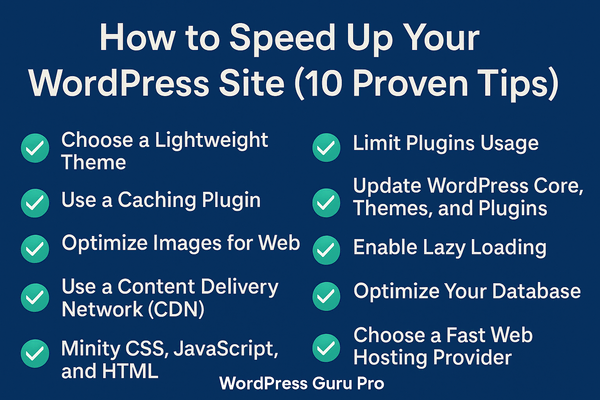
If you’re short on time, here’s a quick recap of the 10 proven tips to make your WordPress site faster. From choosing a lightweight theme and using a caching plugin to optimizing images, enabling lazy loading, and picking a reliable hosting provider — these steps will dramatically improve your site’s load time and performance. Treat this checklist as your go-to reference whenever you want to run a quick speed audit on your site.

Affiliate Disclosure: Some of the links in this post may be affiliate links. This means we may earn a small commission if you click on the link and make a purchase, at no additional cost to you. This helps support our work and allows us to continue providing quality content. We only recommend products or services we believe will add value to our readers.
Connect with Us
Stay updated with our latest WordPress guides, SEO tips, and AI tools. Follow us on social media or reach out via email!
 Website
 Facebook
 LinkedIn
 X (Twitter)
 Email
Email
 Contact
 You May Also Like:
Explore more powerful insights to level up your WordPress and SEO game:
-
 AI-Powered WordPress Tools & Websites: Discover how AI is revolutionizing development workflows in 2025.
-
50 Best ChatGPT Prompts for SEO: Boost your content and rankings with AI-driven SEO strategies.
-
International SEO Execution: Reach global audiences with smart keywords, UX, and backlinks.
-
Organic Search Visibility: Learn what it means and how to dominate your SEO space.
💡 Keep exploring insightful tips and strategies at WordPressGuruPro.com.